China’s biopharmaceutical industry is entering a new phase driven by policy reform, innovation, and global expansion.
China’s Biopharmaceutical Industry Enters a “Strategic Pillar” Era: A Structural Shift Driven by Policy, Innovation, and Capital
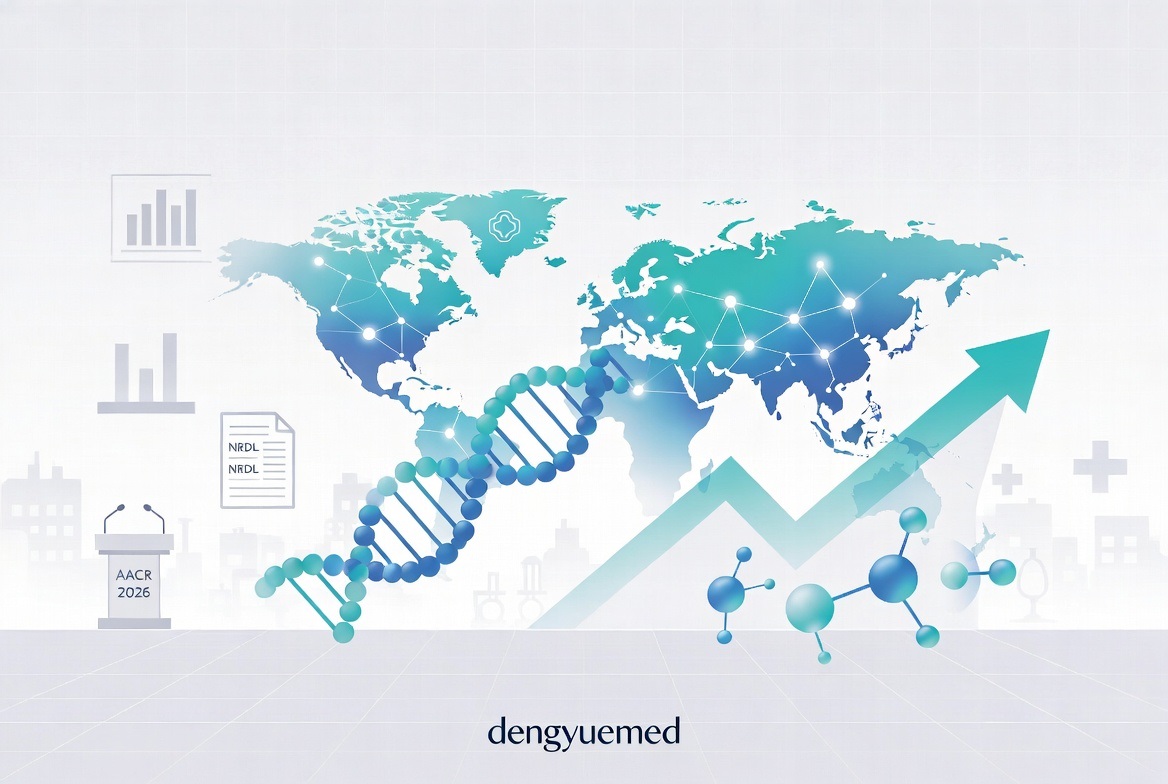
Amid the ongoing reshaping of the global pharmaceutical landscape, China’s biopharmaceutical industry is stepping into a new phase of development — one defined not just by growth, but by structural transformation.
As a cross-border platform connecting China’s innovation pipeline with global clinical demand, DengYueMed has been closely tracking these shifts.
This year, China officially designated the biopharmaceutical sector as a national “strategic emerging pillar industry.” More than a policy upgrade, this signals a redefinition of the industry’s role — from a high-growth sector to a core engine of economic and technological advancement.
In essence, biopharma in China is moving beyond expansion and entering a phase where innovation, efficiency, and global integration take center stage.
From Policy Support to System-Level Enablement
Over the past decade, policy has been one of the most critical drivers of China’s pharmaceutical growth.
Today, that policy framework is evolving from targeted support into a comprehensive, system-level enabler.
Key national strategies — including the 15th Five-Year Plan and the 2026 Government Work Report — underscore biopharma as a cornerstone of “new quality productive forces.”
At the same time, regulatory reforms are reshaping the innovation environment.
Accelerated approval pathways such as:
- Breakthrough Therapy designation
- Conditional approvals
- The Marketing Authorization Holder (MAH) system
have significantly shortened development timelines.
Importantly, China is aligning more closely with global regulatory standards while maintaining its well-known review efficiency.
This dual advantage is enabling faster clinical translation of cutting-edge technologies, including:
- Cell therapies
- Gene editing
- Precision oncology
- Advanced biologics
As a result, a growing number of Chinese innovative drugs are progressing from early research to real-world clinical use at unprecedented speed.
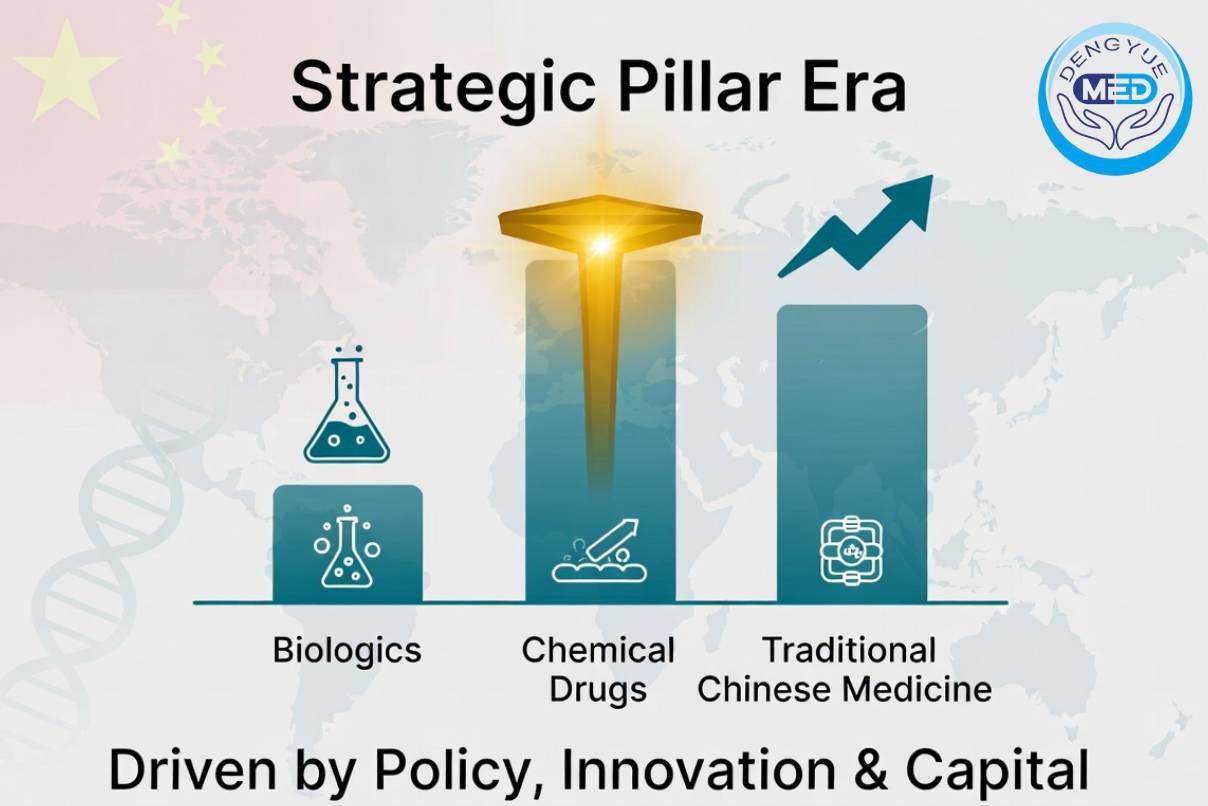
A Three-Pillar Industry — Now with Diverging Roles
China’s biopharmaceutical sector remains structurally anchored in three major segments:
- Biologics
- Chemical drugs
- Traditional Chinese medicine
However, their roles are evolving rapidly.
Chemical Drugs
Accounting for roughly 47% of the market, chemical drugs continue to serve as the system’s foundation.
Driven by:
- Large-scale generic manufacturing
- Centralized procurement policies
this segment ensures affordability and broad accessibility.
Yet growth here is stabilizing, with competition shifting toward quality and efficiency rather than volume.
Biologics
Representing about 28% of the market, biologics have emerged as the primary engine of innovation.
This segment encompasses:
- Monoclonal antibodies
- Bispecific antibodies
- Antibody-drug conjugates (ADCs)
- Cell therapies
- Gene therapies
Leading companies such as BeiGene and Innovent Biologics are advancing novel therapies into global markets, marking a transition from manufacturing-driven growth to innovation-led competitiveness.
The rapid expansion of these pipelines reflects the broader rise of innovative drugs in China’s healthcare ecosystem.
Traditional Chinese Medicine (TCM)
Traditional Chinese medicine, with approximately 25% market share, is undergoing regulatory tightening and modernization.
While short-term output has declined, long-term opportunities remain in:
- Chronic disease management
- Preventive care
- Consumer health
particularly as healthcare awareness continues to rise.
Market Expansion: Beyond Scale, Toward Structural Growth
China’s biopharmaceutical market continues to expand steadily:
- 2024: ~RMB 2.14 trillion (+8.12% YoY)
- 2025: ~RMB 2.24 trillion
- 2026 (forecast): ~RMB 2.31 trillion
However, the real story lies in how this growth is being generated.
Demographic trends — particularly aging populations and rising chronic disease burdens — provide a stable demand base.
Meanwhile, the increasing availability of advanced therapies is unlocking entirely new treatment possibilities.
In parallel, digital technologies such as:
- AI-driven drug discovery
- Big data-enabled clinical trial design
- Intelligent supply chains
are redefining efficiency across the value chain.
Another important indicator of innovation momentum is the rising number of newly approved therapies.
As stakeholders increasingly seek a comprehensive list of approved drugs in China, the country’s regulatory output is becoming a key reference point for global pharmaceutical benchmarking.
Leading Companies Move from Domestic Competition to Global Play
At the corporate level, China’s pharmaceutical leaders are undergoing a fundamental shift — from focusing on domestic markets to competing on a global stage.
Companies such as:
- Jiangsu Hengrui Pharmaceuticals
- Sino Biopharmaceutical
- Henlius
are expanding international clinical trials, pursuing out-licensing deals, and strengthening global commercialization capabilities.
The rise in cross-border licensing transactions signals that China is no longer just a manufacturing hub — it is becoming an active participant in global value creation.
At the same time, emerging biotech firms are increasingly being recognized among top rare disease companies, particularly as China accelerates development in:
- Orphan drugs
- Precision medicine
- Rare disease therapies
The Overlooked Link: Cross-Border Access and Distribution
As China’s innovation gains global traction, a critical question emerges:
How can these therapies effectively reach patients worldwide?
In reality, cross-border pharmaceutical distribution remains highly complex.
Challenges include:
- Regulatory compliance
- Cold-chain logistics
- Customs clearance
- Local clinical integration
This is where infrastructure-like platforms are becoming essential.
DengYueMed plays a pivotal role in bridging this gap — connecting high-quality Chinese drug resources with international healthcare providers while ensuring compliance and supply chain reliability.
In an increasingly digital healthcare landscape, such platforms also complement the growing demand for Chinese online pharmacy models, particularly in regions seeking efficient access to specialized medicines.
Conclusion: The Beginning of a Long-Term Transformation
China’s designation of biopharma as a “strategic pillar industry” marks not an endpoint, but the beginning of a long-term transformation.
What is emerging is a system built on three reinforcing capabilities:
- Regulatory innovation
- Scientific advancement
- Industrial coordination
As these forces converge, China is poised not only to participate in the global pharmaceutical market, but to help shape its future.
In this evolving landscape, DengYueMed will continue to act as a bridge between China’s innovation ecosystem and global medical needs — ensuring that breakthroughs do not remain confined to laboratories, but are translated into real-world access for patients worldwide.